Video: Tukituki candidates draw packed house for Rotary and Lions debate
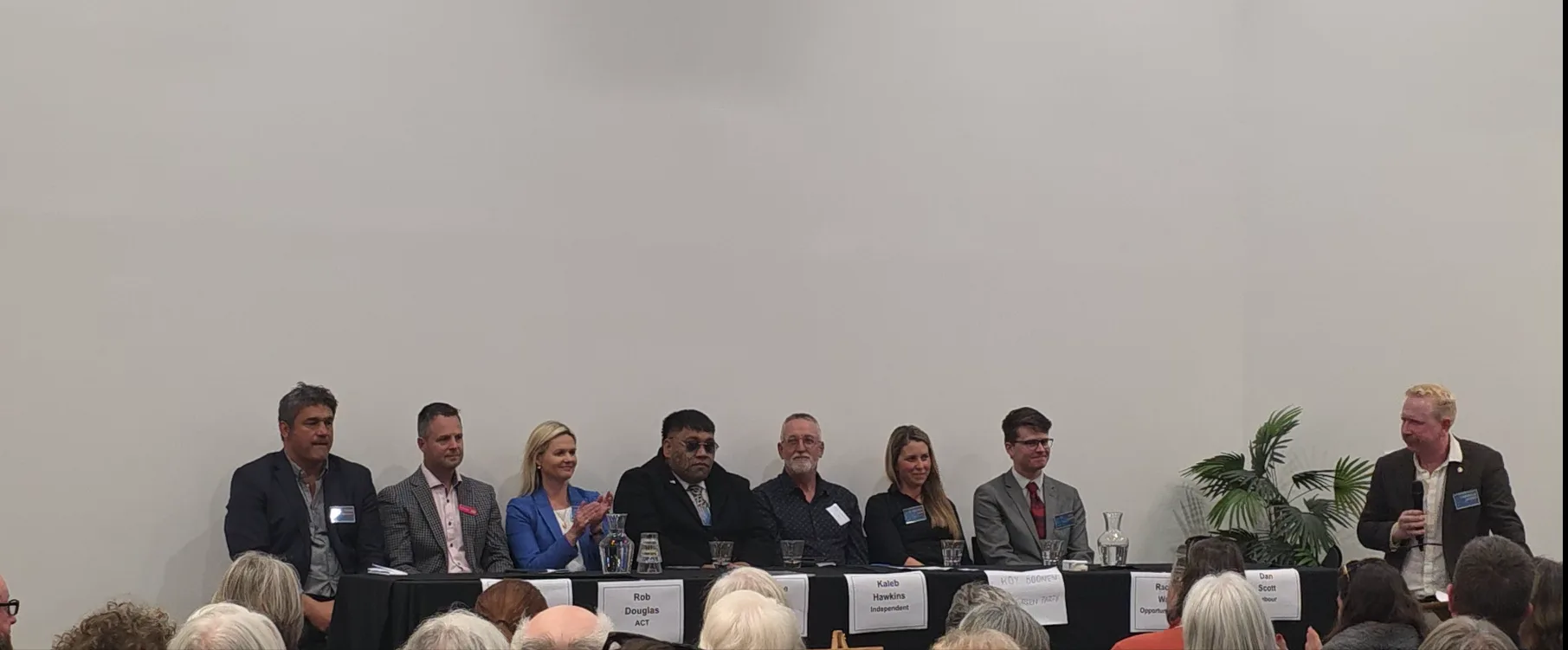
Competing visions for Hawke’s Bay’s future, disagreements over tax and boos from some audience members marked a Tukituki candidates’ debate in Havelock North on Monday night.
Hosted by the Rotary Club of Havelock North and Hastings Host Lions Club, the Meet the Candidates evening at the Havelock North Community Centre was moderated by former Hastings district councillor Marcus Buddo.
It was standing room only as candidates faced questions on the cost of living, the role of government, their parties’ records and what they would prioritise for the region.
National’s Tukituki MP Catherine Wedd, Labour’s Dan Scott, ACT’s Rob Douglas, New Zealand First’s Taine Randell, the Opportunity Party’s Rachel Ward and independent Kaleb Hawkins took part. Green Party Napier candidate Roy Boonen filled in for the party’s Tukituki candidate, who is unwell.
Douglas and Ward both told the audience they were seeking the party vote, with Douglas encouraging voters to give their electorate vote to Wedd.
“My personal preference is that you give your electorate vote to Catherine and give your party vote to ACT. That is, in my view, the most likely way to return the current government.”
Tax was a point of disagreement, including when candidates were asked how proposed changes would affect retirees who were asset rich but cash poor.
Wedd was booed by some audience members several times during the evening, including during her comments on tax. Buddo urged the audience to let candidates speak, saying the reaction was coming across as “just a titch partisan when it's one candidate that's targeted by the jeering rather than all of them”.
Wedd defended National’s opposition to new taxes, arguing that business growth was the way to strengthen the economy and fund public services.
“If you work hard in New Zealand, you should be able to keep more of what you earn and be rewarded for your ambition and your success.”
Scott advocated a targeted capital gains tax on investment property, saying it would encourage investment in businesses and jobs while raising revenue for healthcare. He said the family home and farms would be excluded.
Ward outlined the Opportunity Party’s proposed tax reset, including a land value tax and universal basic income. She said retirees could defer land tax payments and acknowledged the changes would require a long transition and public support.
Boonen argued that changes to the tax system were needed to address inequality, while Randell opposed wealth and land taxes and called for a greater focus on economic growth.
On living costs, candidates offered different explanations for the pressures facing households.
Douglas argued that weak productivity was the underlying problem.
“The reality is we’re not in a cost of living crisis. We are in a productivity crisis in this country.”
He called for less regulation, lower government spending and greater opportunities for businesses to grow.
Scott said Labour’s approach combined better pay, lower bills and stronger public services. He advocated restoring pay equity provisions, tackling price gouging and increasing competition in the supermarket sector.
Wedd said disciplined government spending and business growth were central to lifting incomes. She also argued that removing barriers to housing development and renewable energy projects would increase supply and help bring costs down.
Randell described his approach as a “war on cost” alongside a pathway to growth. He called for changes to the supermarket and electricity sectors, including separating electricity generation from retailing, and emphasised the role of small and medium-sized businesses.
Boonen said the pressure on households could not be separated from the distribution of wealth.
“The cost of living crisis is a spotlight on the inequity in New Zealand.”
He advocated more public housing, affordable public transport and tax changes to improve take-home pay for lower-income earners.
Ward said the Opportunity Party could work across the political spectrum and wanted longer-lasting decisions, rather than policies being repeatedly introduced and repealed.
Hawkins challenged candidates to explain how their promises would be funded and delivered.
“If you’re coming to make us a promise, come and let us know how much it’s going to cost us.”
He said housing, food and power costs would be his immediate focus.
The role and size of government also drew differing views.
Douglas called for a smaller, more accountable government, while Wedd said National believed in limited government and reducing interference in businesses.
Scott and Boonen warned that cutting support staff could leave frontline workers doing more administration. Ward supported greater efficiency but said changes needed to be evidence-based and preserve services.
Asked what their parties had achieved, Wedd highlighted her work on postnatal care and the three-day stay bill. Scott defended Labour’s COVID-19 response, while Douglas pointed to school attendance initiatives and medicine funding.
Boonen highlighted cross-party agreement on climate change and conservation work under former Green ministers. Randell argued for greater energy independence and exploration of New Zealand’s resources.
The final question brought the discussion back to Hawke’s Bay, asking candidates to identify three regional priorities and commit to reporting back on their progress.
Wedd highlighted the expressway, water security and support for horticulture. Scott called for more healthcare staff, a long-term regional jobs plan and environmental protection.
Douglas emphasised youth employment, equal treatment and improving classroom learning environments. Boonen identified youth employment, the environment and healthcare.
Ward’s priorities included healthcare, incentives for landowners to protect waterways and biodiversity, and strengthening the local economy. Hawkins identified water, employment and living costs.
Randell advocated water storage, a more targeted approach to skilled immigration and greater use of solar power, including on council buildings.
Closing the evening, Buddo thanked the candidates for putting themselves forward and the audience for participating in democracy.
“Even when I disagreed with you, I could understand you and where you were coming from.”