Hipkins takes jobs and healthcare pitch to Hawke’s Bay
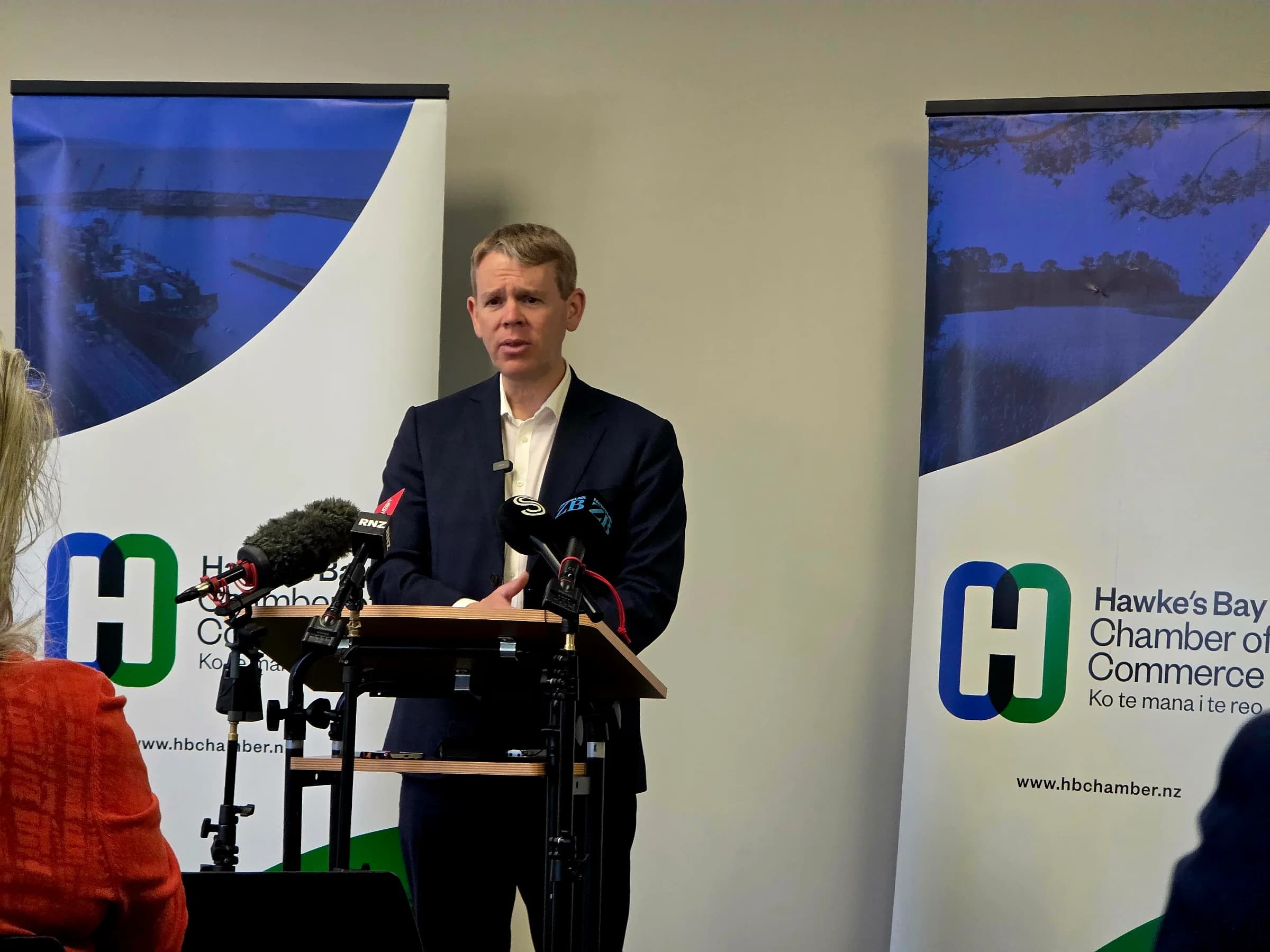
Labour leader Chris Hipkins outlined his party’s plans to support small businesses and guarantee job offers for newly qualified nurses during a campaign visit to Hawke’s Bay.
Hipkins addressed the Hawke’s Bay Chamber of Commerce in Hastings and later visited the Eastern Institute of Technology on Thursday, with 16 days remaining until the general election.
Speaking to Hawke’s Bay News, Hipkins said Labour wanted to address the cost of living and improve healthcare, while supporting the region’s agricultural and horticultural industries.
“We want to get behind those sectors so that they can grow and thrive,” he said.
At the Chamber, Hipkins said getting people into well-paid work was fundamental to easing financial pressure on households.
“The idea that your own hard work should be enough to create a good life for yourself and for your family seems to be getting further and further out of reach for way too many people.”
He said bringing forward government-funded work would help create employment in communities across the country.
Labour proposed repeating the School Improvement Programme introduced during his time as Education Minister, alongside hospital maintenance and a commitment to build 6,000 additional state houses.
Hipkins said smaller projects could keep tradespeople employed while larger developments progressed, helping retain the workforce needed to deliver them.
For small businesses, he outlined proposals to raise the GST registration threshold from $60,000 to $80,000 and increase the immediate write-off threshold for eligible business assets from $1,000 to $10,000.
He said this would reduce compliance costs for smaller operators and allow businesses to deduct the cost of more tools and equipment in the year of purchase rather than depreciating it over time.
“If we back our small businesses, we’re backing job creation in every region of the country.”
Hipkins also outlined $500 monthly payments for employers during the first two years of an apprentice’s training, saying businesses faced significant costs while new apprentices developed their skills. Labour’s published policy would extend the payments from one year to two from July 2028.
He said smaller businesses should receive their fair share of government contracts and be paid on time. He also linked Labour’s proposal to restore locally prepared school lunches to employment in regional communities.
Other household-cost proposals included improving independent grocery retailers’ access to wholesale supplies and allowing people to pay for rooftop solar through rates or lines-company charges rather than meeting the cost upfront.
Hipkins identified solar as an opportunity for Hawke’s Bay to reduce power bills and improve resilience. He also outlined a proposed $10 weekly public transport fare cap for the region.
During the discussion that followed, Chamber chief executive Karla Lee asked how a future government would be held accountable for delivering its commitments.
“Most of us in this room have KPIs,” she said. “And if we don’t reach our targets, we are reprimanded for it or fired.”
Hipkins said Labour’s action plans contained commitments voters could assess after three years.
“I don’t think we can continue the cycle of promising what we can’t deliver.”
He also pledged not to stop projects simply because another government had started them, saying repeated changes in infrastructure priorities cost jobs and money.
“If something’s underway, if it’s funded, let’s keep it moving.”
Hipkins identified an energy import facility as an exception. He said businesses needed policy changes to be signalled in advance so they could prepare.
The region’s infrastructure needs also featured in his interview with Hawke’s Bay News. Hipkins said local mayors had discussed their priorities with him, including flood protection and roading.
“We need to continue the work that was started post Cyclone Gabrielle around rebuilding a degree of resilience here in the Bay.”
He said further investment was needed to protect communities from future disasters.
Hipkins later told media bridges had been a particular concern in those discussions. Some that survived the cyclone remained vulnerable, he said.
“So that job is not done. There’s still a lot of work to be done here around resilience, around rebuilding some of that infrastructure that’s been damaged.”
At the Chamber, Hastings Deputy Mayor Michael Fowler asked whether Labour would allow local government reform to progress, saying some in the region did not want it to stall.
Hipkins described the Government’s process as “terrible”, but said Labour would support changes where communities backed them.
He was open to regional councils being incorporated into unitary authorities where appropriate, while retaining them where a council working across a wider area still made sense.
Asked about water security, Hipkins said the Infrastructure Commission should take a greater role in identifying water-storage opportunities and developing a long-term national plan.
“We’re going to need more water resilience as well, because as you’ve discovered here, sometimes you have not very much and then sometimes you have way too much.”
He said the commission’s cross-party support could help provide consistency beyond individual parliamentary terms.
Concerns about McCain’s decision to close its Hastings processing factory prompted questions about food security and the effects on growers and other local businesses.
Hipkins said he wanted to work with local government and growers to retain domestic food-processing capability.
“We have to make sure we have a resilient local food supply chain.”
Discussing Labour’s campaign with Hawke’s Bay News, Hipkins backed Dan Scott in Tukituki and Alex Hedley in Napier, and said Kieran McAnulty was working to regain Wairarapa. He also praised Cushla Tangaere-Manuel for holding Ikaroa-Rāwhiti for Labour at the last election.