
Video: Health and infrastructure in focus at Labour’s Napier meeting
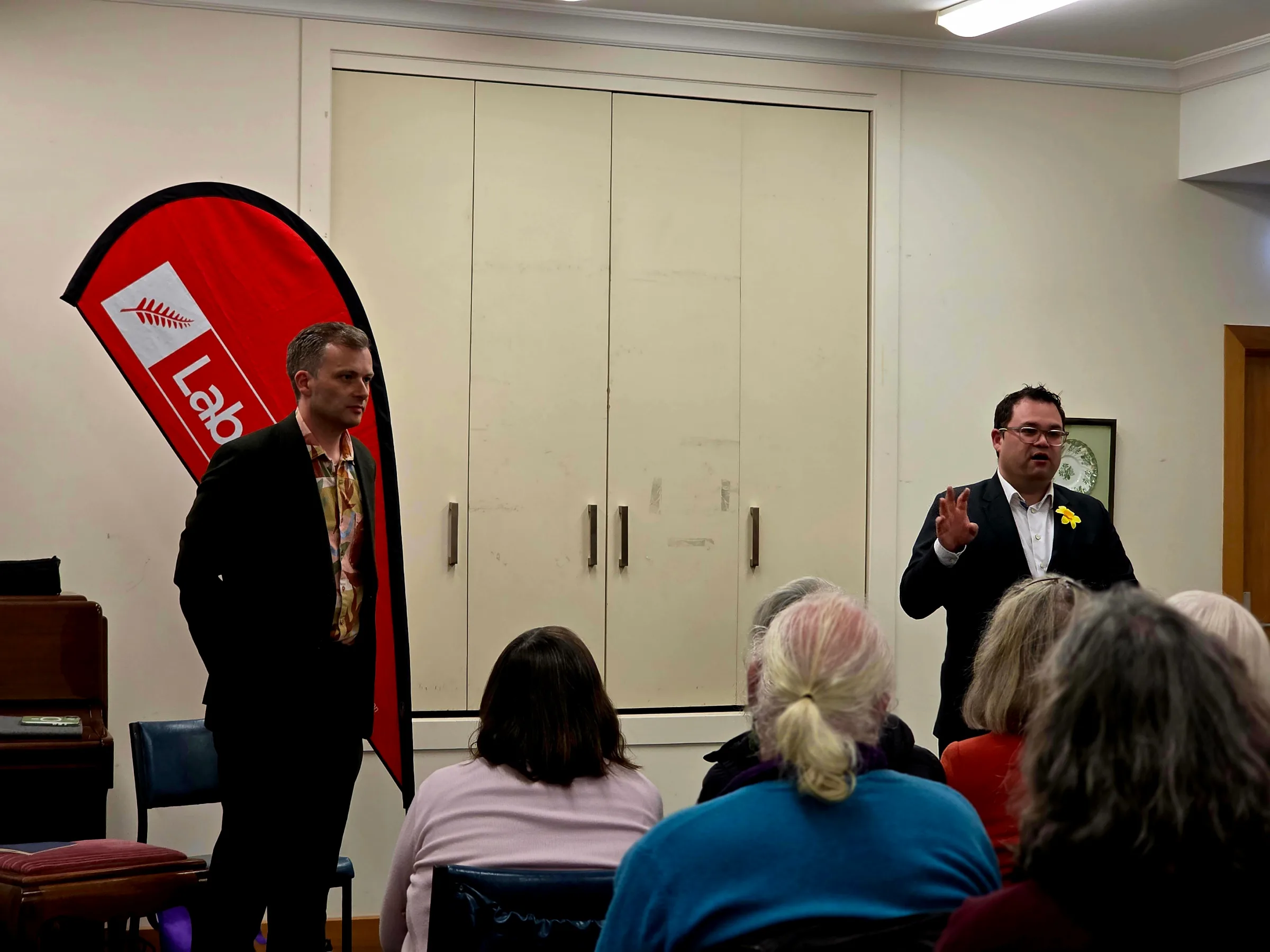
Governments “of both shades” have been guilty of a “flip-flop” approach to infrastructure, Labour’s transport spokesperson told a public meeting in Napier where local government reform and pressure on Hawke’s Bay’s health services were also discussed.
Labour transport and local government spokesperson Tangi Utikere joined Napier candidate Dr Alex Hedley at St Paul’s Church on August 28.
Utikere told the meeting greater political consensus was needed to give communities and the infrastructure sector more certainty.
“We have to get rid of this flip-flop nature that governments of both shades have been guilty of over many years,” he said.
“To be fair, both governments over many decades have been guilty of that approach. And we’ve said that we don’t want to do that. We want to provide certainty.”
Speaking to Hawke’s Bay News after the meeting, Utikere said communities had experienced projects being “cancelled and started and cancelled”.
“We’ve been committed to ensuring that a bipartisan approach is really, really important,” he said.
He said a Labour government would honour infrastructure projects where contracts had been signed, construction was under way, and funding had been secured.
“There’s no suggestion that an incoming Labour government is going to cancel your Road of National Significance here. We will honour those approaches.”
Funding has been approved for the Hawke’s Bay Expressway project and construction began in November last year. The project includes seven kilometres of four-laning between Links Road/Pākōwhai Road and Taradale Road.
Utikere described it as “a much shorter project than was originally announced by the Government” and said Hawke’s Bay needed an integrated approach to transport that included roads and public transport.
He also pointed to Labour’s policy to cap public transport fares at $10 a week outside Auckland, Wellington and Christchurch from July 2027.
Asked how Labour would fund its transport programme without increasing fuel excise tax over the next three years, Utikere said Labour would look at the scope of projects and future Budgets.
He did not identify an alternative funding source, but said ruling out the increases would provide certainty for households.
Local government reform was another focus of the meeting.
Utikere, who spent 10 years as a Palmerston North city councillor and four years as deputy mayor, said Labour accepted reform was needed but was concerned about the time councils and communities had been given to consider the Government’s proposals.
He said Labour would not stand in the way of amalgamation where it had community support, but councils needed enough time to assess the financial implications and how local voices would be represented.
“We’re not talking about giving huge periods of time for councils to drag their heels through this process, but we are talking about a little bit more time than 90 days,” he said.
Utikere also raised questions about where environmental protection, water catchment, public transport and biodiversity responsibilities would sit under changes affecting regional councils.
At the meeting, he said Labour would support the Government’s rates-cap legislation at its first reading so it could go before a select committee.
However, he said there was no guarantee the party would continue supporting it after hearing from councils and communities about its likely effects.
While the meeting was focused on transport and local government, much of the discussion centred on health.
Hedley, a public health doctor, said concerns about Napier’s health services had been a significant factor in his decision to stand for Parliament.
He cited the repeated closures of Napier’s overnight health service and difficulties people faced accessing primary and hospital care.
Audience members raised concerns about access to general practitioners, nurses and women’s health services, as well as health workers leaving New Zealand for better-paid jobs overseas.
At the meeting, Hedley said Labour would shortly announce further health workforce policy. The party has since promised every eligible New Zealand-trained graduate nurse a job in the health system, with roles offered from 2027.
Utikere said the number of health-related questions showed how important the issue was to the Napier community.