
Police treating fire at St Paul’s Presbyterian Church as suspicious
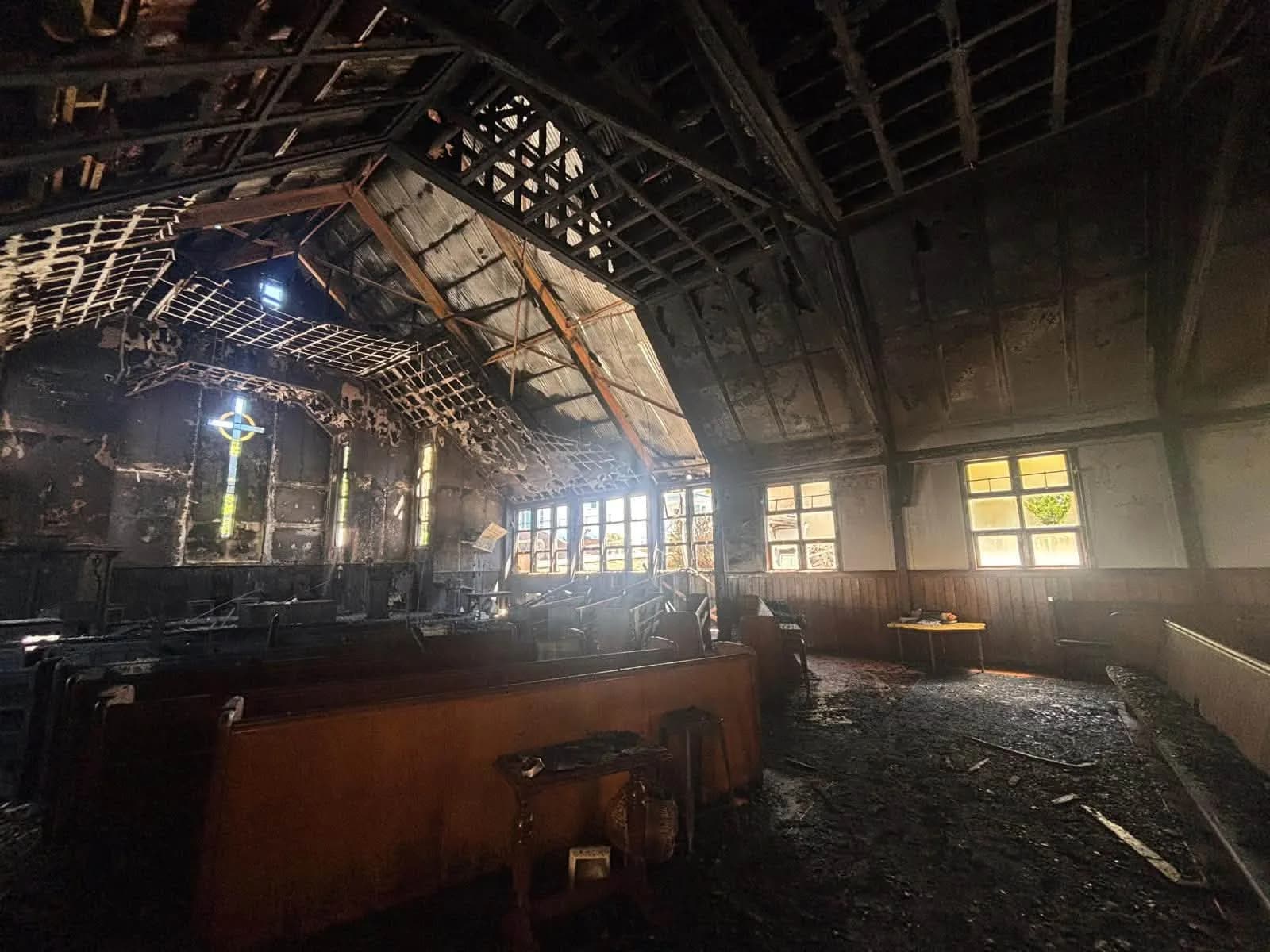
Police are treating the fire that devastated St Paul’s Presbyterian Church in Napier as suspicious, while the displaced congregation prepares to temporarily return to a former home.
The Tennyson Street church was gutted by fire early on Monday morning, causing extensive damage to its sanctuary.
“Police are treating a fire at a Napier church on Monday as suspicious and an investigation is in progress,” a Police media spokesperson told Hawke’s Bay News.
St Paul’s minister Reverend Mark Johnston said Fire and Emergency New Zealand had also indicated the blaze did not appear to have been caused by an electrical fault or other accident.
“The police have said that it’s suspicious enough for them to be investigating and following up leads,” Johnston said.
He stressed investigators had not yet reached a final conclusion about what caused the fire.
Meanwhile, the congregation will hold its Sunday services at Asher Hall, near the Tennyson Street church.
The hall was built by St Paul’s in the 1950s on the site of its former church and remained in its ownership until earlier this year, when it was sold to Bay Vineyard Church.
Johnston said Bay Vineyard had offered the congregation use of the building on Sunday mornings.
“They have just said, ‘Look, you have the run of the place. This is part of who you are as well’.”
He said returning there would be particularly meaningful for some of the church’s older members.
“We’re very blessed actually to have a place to go back to, in a funny kind of way, that’s still got part of our identity stamped on it.”
The arrangement will be temporary while St Paul’s considers the future of its damaged Tennyson Street site.
Johnston said the fire had caused extensive damage, particularly to the church sanctuary, which could hold about 300 people.
The blaze took hold in a section added to the church in the 1950s before spreading back into an earlier part of the building.
“There’s extensive damage and a burnt-out nature and a roof structure which will not be able to be reused,” he said.
Insurers had already visited the site and assessments were under way to determine what could be retained.
“Certainly there is stuff that will have to be demolished.”
The church’s modern administration and lounge block escaped the flames, with Johnston praising firefighters for containing the blaze to the main body of the church.
For the congregation, he said, the loss was about much more than the physical damage.
“It’s incredibly disruptive, it’s incredibly painful for a lot of our people who have been in this place and worshipped and served in this place for a very long time, so there’s a lot of grief.”
The church has also been used by the wider community for classical music, civic gatherings, weddings, funerals and baptisms over many decades.
“There is a huge amount of memory and meaning wrapped up in this site, but particularly the interior of the church, which has been devastated.”

Johnston said if investigators ultimately established that someone was responsible for the fire, he would not hold ill will towards them.
“If it is a criminal act, it’s a criminal act and has to be dealt with by justice means,” he said.
“I won’t hold any ill will towards such a person.”
The latest fire adds another chapter to a history stretching back 168 years.
St Paul’s original wooden church was destroyed by fire in 1929.
A replacement was nearing completion when the 1931 Hawke’s Bay earthquake struck, with fire sweeping through Napier and destroying the new building.
“We feel like we are not just one generation facing this, but we are a succession of generations that have endured,” Johnston said.
Despite the scale of the latest damage, he said the congregation intended to continue and rebuilding remained firmly in its thinking.
“It doesn’t mean we’re not going to rebuild, it doesn’t mean we’re not going to continue.”
A public acknowledgement and karakia will be held outside the damaged church on the Tennyson Street frontage at 9.30am on Sunday.
Blackboards and chalk have also been placed on the security fencing around the building, allowing people to leave messages and memories.
Johnston said the church had been overwhelmed by the response from the community.
“We’re just so grateful for the outpouring of aroha and regard for this place and the way in which it’s steeped in people’s consciousness and memories.”
The congregation will now wait for assessments of the building before determining the longer-term future of the site.
“We will need to regather ourselves and work out what the next step is here.”