Candidates challenged on Central Hawke’s Bay’s future at Wairarapa debate
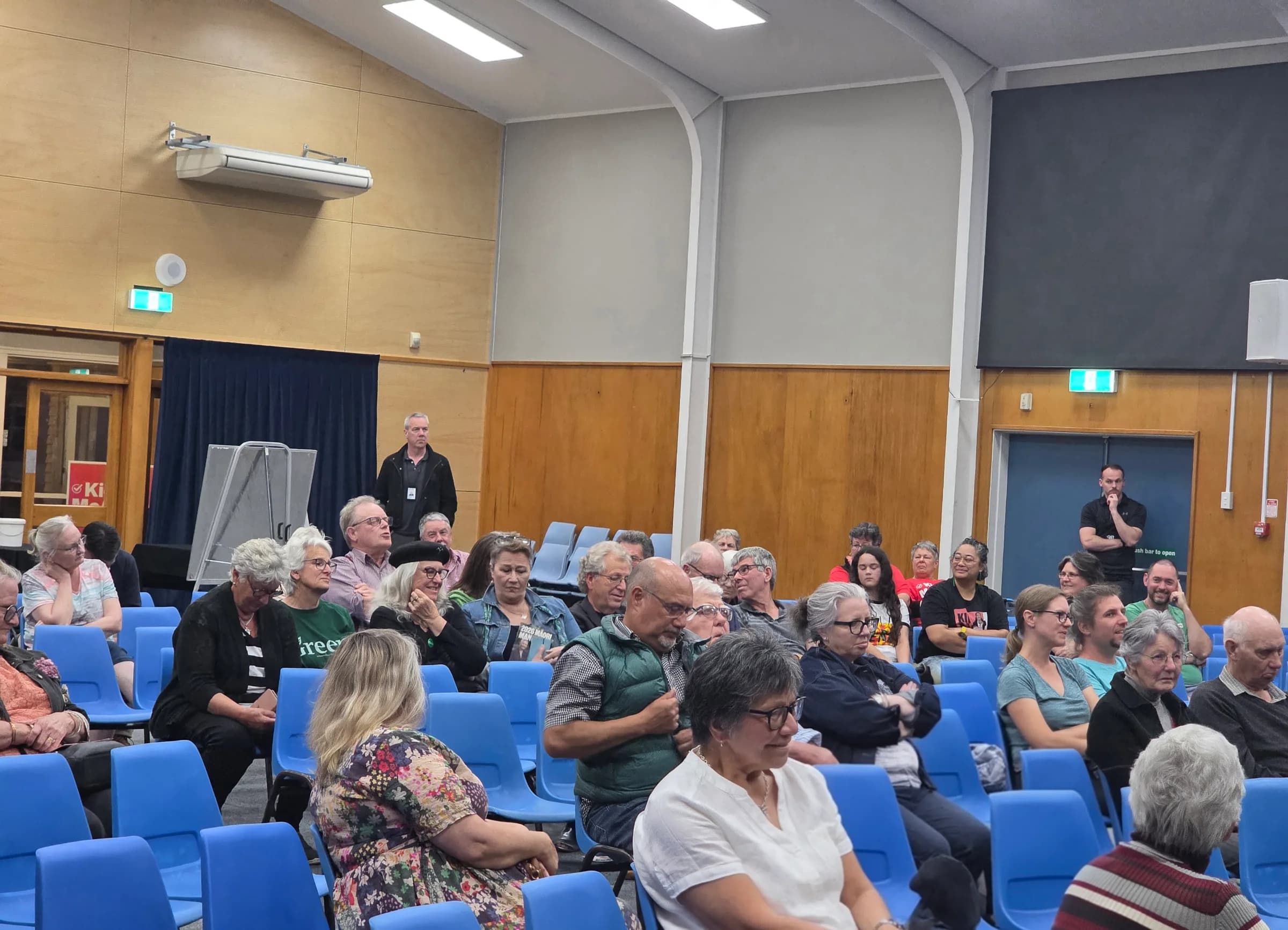
Questions over methamphetamine harm, water storage and young people’s wellbeing drew competing promises and pointed exchanges at last night’s Wairarapa electorate debate in Waipukurau.
Labour’s Kieran McAnulty and ACT’s Rob Douglas clashed over the Government’s record on crime and methamphetamine harm, while candidates outlined different approaches to water storage and support for local communities.
National’s Wairarapa MP Mike Butterick, Green candidate Lauren Craig and the Opportunity Party’s Matt Shepherd also took part at Central Hawke’s Bay College.
Douglas, ACT’s Tukituki candidate, represented his party because it is not standing a candidate in Wairarapa. New Zealand First candidate Ron Mark was unable to attend.
The evening was organised by Hawke’s Bay Today and moderated by its editor, Chris Hyde.
The exchange over methamphetamine followed a question from Business and Professional Women Central Hawke’s Bay about addiction and the lack of local detox and rehabilitation services.
Douglas argued for continued action against gangs, pointing to the Government’s approach to sentencing and imprisonment and saying crime had fallen.
An audience member called out “answer the question” as he discussed crime figures.
McAnulty challenged Douglas, saying methamphetamine use had reached record levels under the Government.
“Let’s deal with facts rather than slogans here.”
He said communities such as Central Hawke’s Bay needed government investment to address addiction.
“I will not ever accept the argument that government needs to get out of the way and therefore this is their own fault, and they can fix it themselves.”
Douglas returned to the exchange when answering the next question.
“Firstly Kieran, I didn’t say that meth had gone down, I said that crime had gone down — so please don’t misrepresent me.”
Craig called for an evidence-based approach, with properly resourced harm reduction services and support for local health providers and community groups.
Shepherd advocated a long-term, bipartisan health plan and sustained funding to improve access to services such as rehabilitation in the regions.
Butterick said tackling methamphetamine required action on supply and demand, alongside support for people experiencing addiction.
He pointed to government initiatives aimed at reducing substance harm and improving access to services.
“Is that enough? It will never be enough. There’s always going to be more to do.”
Water storage also exposed differences, with candidates asked about National’s proposed $300 million in loans for projects and the Tukituki Water Security Project.
Butterick said reliable water supplies were critical to households, farming and processing businesses, and the region’s ability to attract investment.
He outlined National’s proposed rural and provincial water use strategy, saying projects would be prioritised using factors including climate risk, commercial demand and potential benefits for flood mitigation and electricity generation.
McAnulty said water storage was worth exploring, but proposals should undergo independent assessment by the Infrastructure Commission.
“Every proposal needs to be assessed on its merit.”
He said planning needed to consider town supplies as well as agriculture.
Douglas backed the Tukituki project, saying it could be transformational for Central Hawke’s Bay. However, he favoured removing regulatory barriers to encourage private investment.
“We need a system that creates certainty for investors rather than seeing millions of dollars wasted on consultants, lawyers and consent hearings.”
Shepherd said improving efficiency and reusing existing water supplies should be considered first. Where storage was needed, he favoured smaller, distributed and on-farm options.
He supported loans where a transparent cost-benefit assessment justified them, and called for community involvement in decisions.
Craig raised concerns about the Tukituki project’s environmental effects and opposition from community groups and mana whenua.
“We need to look at what the actual impact of these projects is.”
Later, responding to an audience question about water allocation and consenting, McAnulty said Labour would change the Government’s fast-track regime to incorporate community voices and previous environmental court decisions.
Energy policy provided another opportunity for a political dig.
When an audience member described a government energy policy as “dumb”, McAnulty responded: “It’s almost as dumb as selling the ferries.”
The remark drew laughter from the audience.
Questions about young people’s wellbeing also featured, including what made a suitable school lunch.
Butterick said children should have a healthy, nutritious lunch, adding that he took sandwiches to Parliament.
Shepherd offered a teacher’s perspective: “The one that they’re willing to eat.”
McAnulty said lunches should be locally made, healthy and edible, while Craig also supported using local suppliers.
Eleven-year-old Lagi Sauni-Keys questioned the candidates about reducing vaping and alcohol harm among young people.
McAnulty said flavours, colours and promotions targeting young people needed to be addressed. Butterick agreed youth vaping was a concern, while Craig called for stronger regulation.
Speaking to Hawke’s Bay News afterwards, Lagi also questioned the quality of school lunches, saying she did not consider them nutritious or filling.
Her mother, Ina Patisolo, said she was nervous about the election and concerned about the future facing younger generations.
For Lagi, the stakes extended beyond this election.
“I’m worried about the future of New Zealand and what it will be when I can vote. I want to see more focus on education, health, social issues and pollution.”